…How Strategic Design Converts Visitors into Customers
When most people think about “web design,” they think about colours, fonts, and nice-looking images. They believe the goal is simply to make a website that “looks good.”
While aesthetics are important, a website that’s only a pretty picture is little more than an expensive digital brochure. It might look nice, but it won’t do anything to grow your business.
A truly effective website is built on a foundation of strategic design. It’s the invisible thinking that guides your visitors from the moment they arrive to the moment they become a customer. It’s what turns your website from a passive cost into your hardest-working sales tool.
So, what does this “strategic design” actually involve? Let me pull back the curtain.
1. I Create a Clear Path for Your Visitors
Imagine a customer walking into a cluttered shop with no clear aisles or signs. They’ll get confused and leave. Your website is no different. You can’t expect visitors to randomly stumble upon what they need.
Strategic design is about intentionally mapping out their journey.
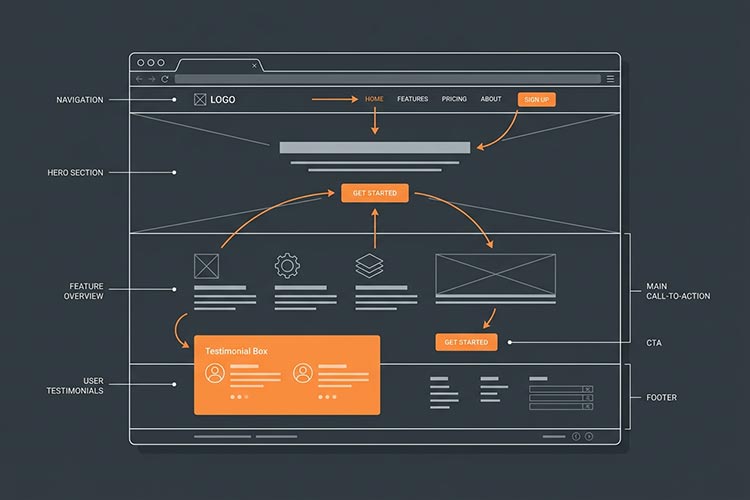
- A visitor lands on your blog from a Google search. What’s the next logical step? We can guide them to a related service page with a clear call-to-action.
- Someone clicks from your Facebook page. They already know your brand, so we can lead them straight to a special offer or your contact form.
My job is to anticipate these paths and build clear, logical signposts into the design, making it effortless for visitors to take the exact step you want them to take.
2. I Build Your Pages to Answer Questions, Not Just Show Information
A visitor on your website has a series of questions, and they want answers fast. A strategic design anticipates these questions and answers them in the order your visitor is thinking them.
Think about a page for one of your key services. A visitor’s internal monologue might be:
- “Have I landed in the right place?” (Answered instantly with a clear, benefit-driven headline).
- “What exactly is this service and is it for me?” (Answered with a concise opening paragraph).
- “How will this solve my problem?” (Answered with a scannable list of benefits or features).
- “Can I trust this business?” (Answered with a client testimonial or case study).
- “Okay, I’m interested. What do I do now?” (Answered with a compelling call to action).
My design process involves structuring your pages to follow this natural flow, ensuring we build confidence and remove friction at every step.
3. I Use Design to Build Instant Trust and Credibility
You have about three seconds to convince a new visitor that you are a legitimate, professional business they can trust. A sloppy or generic design will send them running to your competitors.
Strategic design uses “trust signals” to make a powerful first impression. This includes:
- Professional Branding: Consistent use of your logo, colours, and fonts.
- High-Quality Images: Authentic photos of you, your work, or your location instead of cheesy, generic stock photos.
- Proof of Your Expertise: Prominently displaying client testimonials, reviews, case studies, or industry certifications.
- Clear Contact Information: An easily accessible phone number and address shows you’re a real, local business.
4. I Tell Your Visitors Exactly What to Do Next
This is the most crucial part. A website can do everything else right, but if it doesn’t clearly ask the visitor to take action, it will fail to generate business.
This is your Call to Action (CTA), and it’s both a science and an art. Strategic design involves:
- Using Action-Oriented Language: “Get a Free Quote” is much stronger than “Submit.”
- Creating Visual Contrast: Making your main CTA button a distinct, unmissable colour.
- Placing it Logically: Putting the CTA right where the visitor has finished considering their options.
- Asking at the Right Time: Not every visitor is ready to “Buy Now.” Some might need a softer CTA like “Download Our Free Guide” first.
Is Your Website a Tool or Just a Decoration?
A beautiful website is nice. But a beautiful website that systematically guides visitors, builds trust, and generates leads is a game-changer. That is the difference between simple decoration and true, strategic design.
Is your current website actively working for your business? If you’re ready to invest in a strategic website designed to get real-world results, let’s have a conversation.
Contact Jollyfox today for a free, no-obligation consultation.