When businesses want more leads fast, PPC (pay-per-click advertising) often feels like the obvious first move.
Ads promise instant visibility, immediate traffic, and quick wins. But here’s the truth many agencies won’t tell you upfront:
If your SEO isn’t solid, PPC will only highlight your problems — and increase your spend.
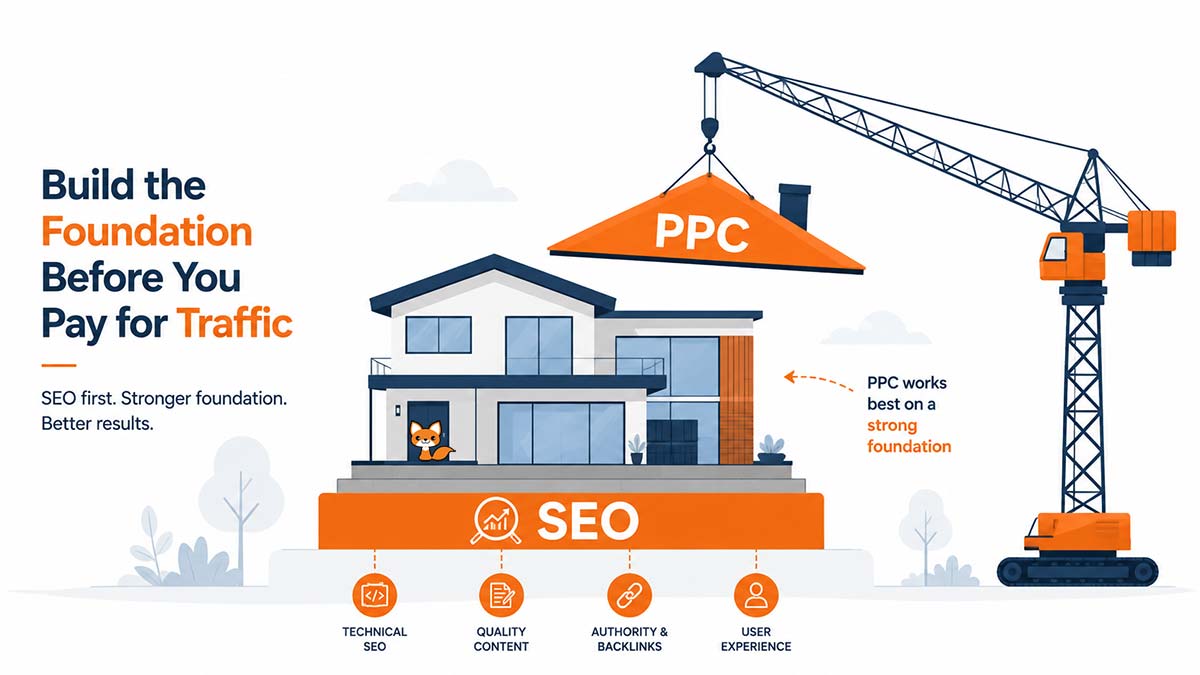
Before you spend anything on ads, you need to make sure your foundation is strong. That foundation is SEO.
SEO Is the Engine. PPC Is the Fuel.
Think of SEO as building a high-performance engine, and PPC as pouring fuel into it.
If your website:
- loads slowly
- isn’t optimised for search intent
- has weak content or poor structure
- doesn’t convert visitors
then PPC won’t “fix” any of that. It will just send more paid traffic to a site that isn’t ready to convert — which means higher costs and lower returns.
SEO forces you to get the fundamentals right:
- clear messaging
- logical site structure
- fast load times
- mobile optimisation
- content that actually answers user questions
These improvements benefit every channel, not just organic search.
SEO Reduces PPC Costs (Yes, Really)
Google doesn’t just care how much you bid. It cares about quality.
Strong SEO improves:
- landing page relevance
- user experience
- engagement metrics
All of this feeds into Quality Score — which directly affects how much you pay per click. A well-optimised site often pays less per click than a poorly optimised one, even when bidding against the same competitors.
So when SEO comes first, PPC becomes cheaper and more effective.
SEO Data Makes PPC Smarter
SEO gives you real insight into:
- what keywords actually convert
- how users search at different stages of the funnel
- which pages perform best
Instead of guessing with ads, you can use SEO performance data to:
- target proven keywords
- write better ad copy
- build higher-converting landing pages
That’s not theory — that’s strategy.
SEO Builds Long-Term Value. PPC Stops the Moment You Stop Paying.
PPC is a tap. Turn it off, and the traffic disappears.
SEO, on the other hand, compounds:
- content keeps ranking
- pages keep attracting leads
- authority builds over time
The best businesses don’t rely on one or the other. They use SEO to create consistent, sustainable traffic — and then use PPC to scale what already works.
The Smart Order: SEO First, PPC Second
This isn’t an anti-PPC argument. PPC is powerful when used correctly.
But the smartest approach looks like this:
- Build a strong SEO foundation
- Optimise your site for users and conversions
- Let organic data guide your strategy
- Use PPC to amplify success — not compensate for weaknesses
When SEO comes first, PPC stops being a gamble and starts being an investment.